ASYA MARAKULINA
Asya Marakulina (RUS, 1988) is a multidisciplinary artist who lives and works in Vienna. Her practice encompasses drawing, painting, embroidery, ceramics, animation, video, and installation. Through these diverse media, she explores the poetic relationships between human beings, nature, and the city, with particular attention to transience, personal memory, and the traces we leave behind in the world around us.
“I try to understand, through my work, the laws by which nature and humans live,” Marakulina says. “How we shape and influence one another.” She carefully observes her surroundings—cities, people, plants, streets—and develops a visual language in which inner experience and outer reality converge. Her works balance between the intimate and the public, the tangible and the ephemeral.
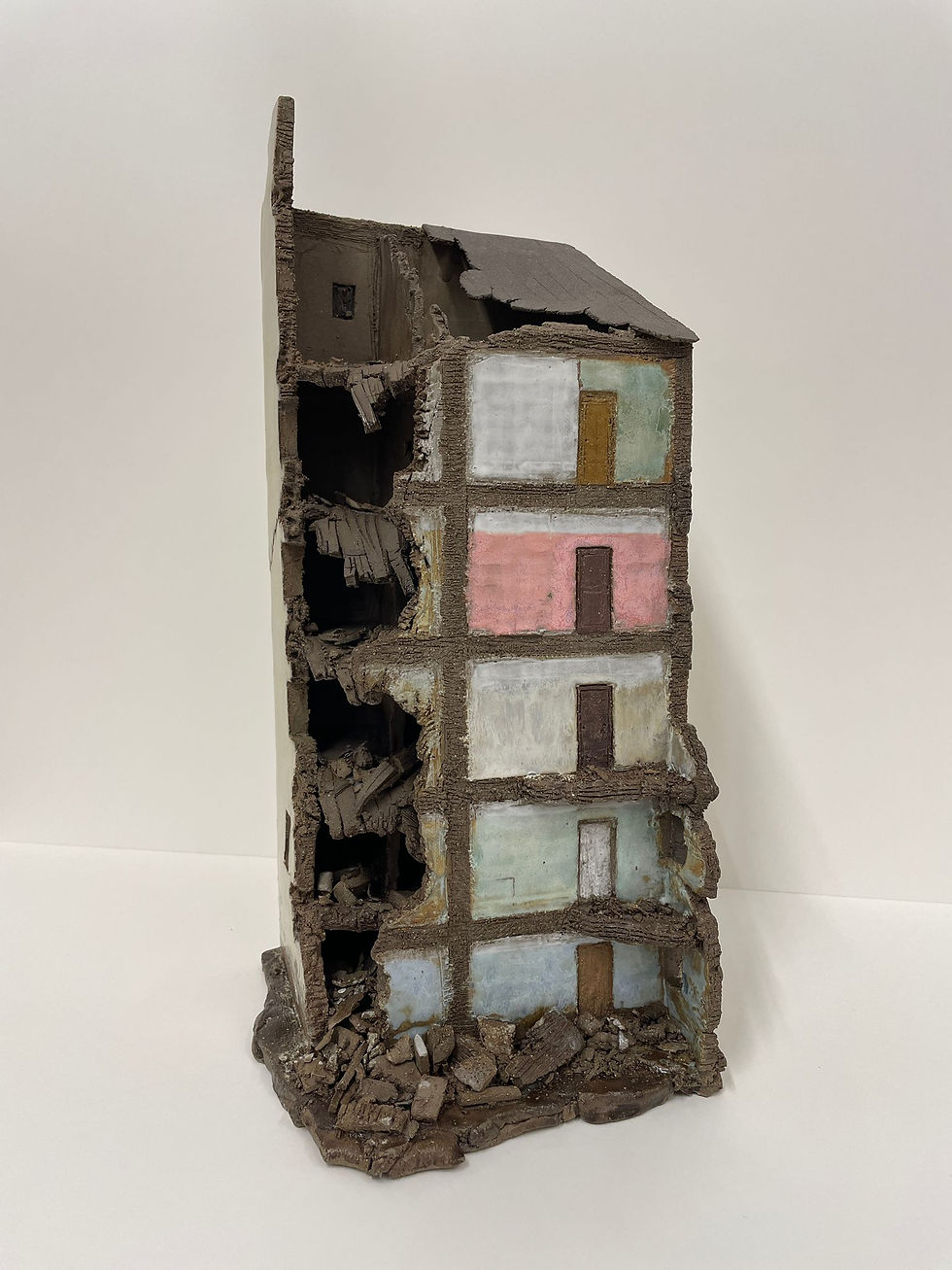
A powerful example of this approach is her ceramic series There Was a Home, in which demolished houses are depicted as fragile portraits of human presence. Inspired by the densely built houses of the 19th century—first in St. Petersburg and later in Vienna—Marakulina reveals the “scars” that remain when a single building is torn down and the adjoining façade is suddenly exposed. Traces of wallpaper, children’s rooms, plumbing, and tiles become visible to the public, though they were once intended to remain private.
These remaining walls, captured in ceramic reliefs, evoke a profound sense of melancholy. They reveal the suddenly exposed inner lives of others—unfolded, almost painfully intimate. “Perhaps these images move me so deeply because part of someone’s domestic existence suddenly becomes visible to the entire street,” Marakulina reflects. She likens houses to living bodies: carriers of memory, emotion, and history.
The ceramic portraits in There Was a Home are based on real buildings—photographed or found online—but Marakulina allows herself artistic freedom in color, structure, and detail. At times she incorporates graffiti, fragments of news texts, or traces of war and loss. The works function like collages of places and eras—images that are at once deeply intimate and universally resonant.
Series: There was a home
Asya Marakulina Sculpts Poignant Ceramic Portraits of Demolished Homes. Prior to the 20th century, apartment buildings and row houses were often built with shared walls between adjoining properties. Intrigued by these aging structures, Vienna-based artist Asya Marakulina began cataloging examples she first noticed on walks around her former home in St. Petersburg, Russia. “Since houses in the 19th century were built without gaps between them, when one house is torn down, the neighboring house often bears traces of the demolished one,” Marakulina tells Colossal. These remnants of decor, plumbing, and other signs of human habitation form the basis of her ongoing ceramic series, There Was a Home.
When Marakulina moved to Vienna, she noticed a similar phenomenon in the remains of older buildings that had been demolished there, too. Fragments of floor still clung to the walls and the outlines of painted or papered rooms were suddenly—somewhat uncomfortably—external. The ease of a warm interior and its associated domesticity was upended. “What touches and affects me the most in images of ruined houses are the traces of wallpaper, tiles, and children’s rooms, which suddenly become visible to the entire street,” the artist says, sharing that the sight evokes a deep sadness. “These spaces were never meant to be seen in such a way.”
Marakulina likens houses to the bodies of living organisms, imbued with emotions, memories, and layered histories. The ceramic cross-sections take on a portrait-like quality, capturing straightforward views of multistory edifices that are simultaneously immediate and intimate. “Maybe that’s why these images captivate me so much because a part of someone’s inner, domestic life is suddenly turned inside-out and put on public display,” she says. The houses in There Was a Home are typically drawn from real buildings, photographs of which she captures herself or finds on the internet.
Marakulina also considers the impacts of war and is profoundly moved by the current conflicts in Ukraine and the Middle East, where thousands of homes have been destroyed and their inhabitants killed or displaced. The half-standing homes simultaneously represent lives lost and the hope of one day being able to rebuild. Rather than straightforward copies of the buildings she encounters, Marakulina takes liberties with wall colors, sometimes adding graffiti or words she sees on the streets or derives from the news. She scores the clay to create the textures of tile and concrete or delineate lintels and former doorways. The resulting reliefs become collage-like, merging locations and motifs. (
Text: Kate Mothes)
For an overview of the available works click HERE